
Bakhchisarai
Bakhchisarai, the Khan’s Palace and Crimean Tatar heritage
Bakhchisarai is a historic city in Crimea, set in a valley among the mountains of the peninsula’s interior. Its name can be translated approximately as “Palace of the Garden”, a reference to the monument that has defined much of its history: the Khan’s Palace. From the sixteenth century, Bakhchisarai served as the capital of the Crimean Khanate, ruled by the Giray dynasty and closely connected with the Ottoman Empire.
The city remains strongly associated with the culture of the Crimean Tatars, a Turkic-speaking Muslim people whose complex history includes the mass deportation ordered by Stalin in 1944. Mosques, historic houses and monuments preserve a cultural heritage quite distinct from that of many other cities on the peninsula.
Bakhchisarai is also surrounded by dramatic rocky valleys, cliffs and cave settlements, making the landscape around the city an important part of the experience.
What to see in Bakhchisarai
The principal monument is the Khan’s Palace, or Hansaray, begun in the sixteenth century as the residence of the rulers of the Crimean Khanate. The complex includes courtyards, residential rooms, gardens, mosques and fountains.
Its most famous feature is the Fountain of Tears, which was immortalised in a poem by Alexander Pushkin. The complex also contains the Great Khan Mosque, distinguished by its two slender minarets.
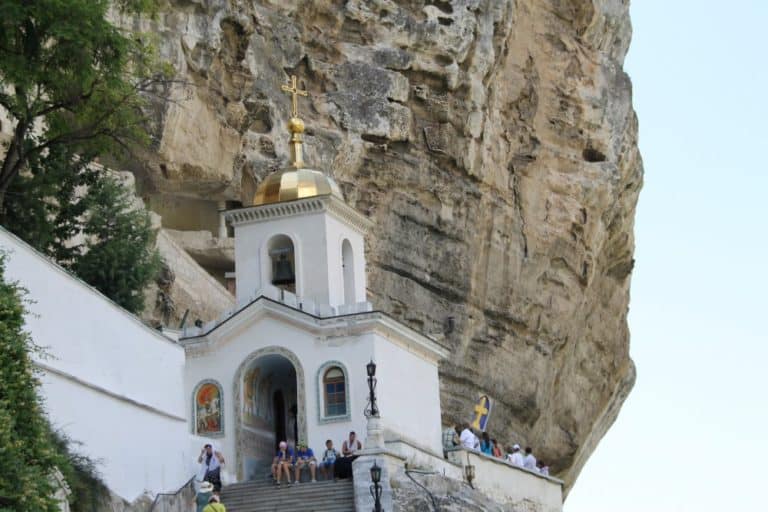
Outside the city stands the remarkable Dormition Monastery, also known as the Uspensky Monastery. Built into the cliffs of a narrow valley, parts of its churches and monastic spaces are carved directly into the rock.
Continuing through the valley leads towards Chufut-Kale, an ancient fortified settlement occupying a high plateau and containing historic buildings and rock-cut structures.
When to visit Bakhchisarai
Spring and early autumn generally offer the most comfortable weather for exploring the city and surrounding landscapes on foot.
Given the current geopolitical and security situation, anyone considering travel to Crimea should first consult the latest official travel advice applicable to them.
Cave monastery
[ July, 2013 ] In Bakhchisarai in Crimea, there is a cave monastery, called Uspensky Monastery. There is no evidence, but they say it was founded in the 8th century. It is built into the…
