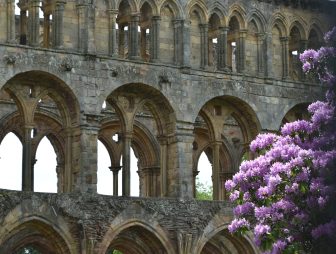

[June 2026] On a day trip from Edinburgh to Melrose, Scotland, I noticed that the bus we boarded at the Tweedbank railway station was bound for Jedburgh.

It suddenly occurred to me that Jedburgh was home to the skeletal abbey ruins I so admire.
I checked online while in Melrose, and sure enough, I was right.
Having come this far, I simply couldn’t pass up the chance to visit.
After enjoying Melrose, we headed to the bus stop, and the hourly bus arrived just as we got there.
It felt like fate.
The journey took a little over 30 minutes, and the fare was £6.20 per person (approximately €7.22).

Jedburgh struck me as a relatively prosperous and peaceful town.
A gentle uphill walk from the bus stop brought us to the imposing sight of Jedburgh Abbey.
We paid the entrance fee (£7.50 per person; £6.00 for those 65 and older) and entered the grounds.
The weather had been lacklustre that day, but the sun happened to break through just then, revealing a magnificent view.
It was the best-preserved abbey ruin I had ever seen, exuding a sense of true grandeur.

An information panel revealed that the abbey was built in the early 12th century.
Although it underwent numerous repairs during the conflicts between Scotland and England in the mid-16th century, it was ultimately destroyed by fire.
These abbey ruins across the Scottish Borders were all commissioned by the Scottish king of the time during the 12th century, intended to bring stability to a region that had fallen into disarray.
The initiative also aimed to develop local industry by inviting monastic orders from continental Europe and introducing agricultural and wool-processing techniques.
It seems this served to announce to the world that Scotland was a Catholic nation within Europe.

However, come the 16th century, these monasteries in the Borders region became prime targets during conflicts with England; furthermore, the Scottish Reformation of 1560 led to the abolition of the Catholic monastic system itself.
That explains why all these abbeys fell into ruin and were reduced to mere skeletons of their former selves.
I am very pleased that, in addition to the magnificent ruins here at Jedburgh, we were able to visit the abbey ruins at Melrose and Kelso during this trip.
The only one left in the Borders region is Dryburgh Abbey.
I hope to visit it someday.
Incidentally, the town of Jedburgh offers more than just abbey ruins; it is also home to castle ruins and a museum dedicated to Mary, Queen of Scots, so staying overnight there might be a good idea.